

AI is changing the thermal requirements of data centers faster than many existing facilities can be rebuilt.
For years, conventional data centers were designed around relatively predictable rack densities and air-based cooling. The arrival of GPU-intensive AI infrastructure is changing that assumption.
Rack densities are increasing rapidly, and liquid cooling is becoming an increasingly important part of the thermal strategy for high-density compute. Recent industry discussion has therefore shifted away from whether liquid cooling will be needed toward how it can be introduced into existing infrastructure.
For greenfield AI data centers, the answer can be relatively straightforward: cooling infrastructure can be designed around liquid-cooled IT from the beginning. For existing facilities, however, the transition is rarely so simple.
The building may have years of useful life remaining. Existing chillers, air-conditioning systems, racks and distribution infrastructure may still represent significant investment. More importantly, not every part of the facility, or every generation of IT equipment, will transition to liquid cooling at the same time.
This creates a more practical question: How can operators introduce higher-density AI infrastructure without rebuilding the entire cooling architecture?
The answer starts by understanding what is actually limiting the transition. Two different constraints require two different retrofit strategies.
When discussing liquid cooling retrofits, it is useful to separate two questions:
Is the IT equipment ready for liquid cooling? And is the facility infrastructure ready to support it?
These questions lead to two very different retrofit scenarios.
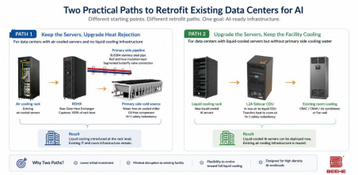
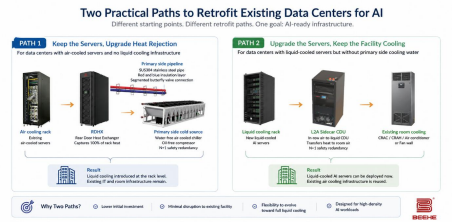
Path 1: The servers are still air-cooled
Many existing data centers will continue operating air-cooled servers for years, even as rack densities increase.
In this situation, replacing the servers or redesigning the entire white space simply to introduce liquid cooling may not make economic or operational sense.
A Rear Door Heat Exchanger (RDHx) provides a practical intermediate step.
Installed directly at the rear of the rack, the RDHx captures hot exhaust air close to its source and transfers the heat into a liquid loop before the air returns to the data hall. This allows operators to increase cooling capability while keeping the existing air-cooled IT architecture largely unchanged.
For retrofit projects, this has an important advantage: liquid cooling can be introduced at the rack level without requiring liquid to enter the servers themselves.
RDHx solutions are therefore particularly relevant where operators need additional cooling capacity but want to minimize disruption to existing IT equipment. The approach has also been highlighted elsewhere in the industry as a practical route for extending the capability of existing facilities as AI densities increase.
But the RDHx should not be considered in isolation.
A complete system still requires a heat-rejection path. Depending on the existing facility, that may involve an available chilled-water loop or a dedicated air-cooled chiller, together with piping, flow control, monitoring, leak detection and redundancy.
In BEEHE's architecture for this scenario, for example, RDHx units are connected through a primary-side piping network to an oil-free air-cooled chiller, allowing an existing air-cooled data hall to gain liquid-based heat rejection without changing the servers themselves.
The principle is simple: Keep the IT architecture. Change how the heat leaves the rack.
Path 2: The servers are liquid-cooled, but the building isn't
The second scenario is becoming equally important.
An operator may want to deploy new direct-to-chip liquid-cooled AI servers, but the existing data center has no suitable facility cooling-water loop.
This creates a different infrastructure gap.
The IT equipment requires liquid cooling, but installing new facility-wide chilled-water piping may require significant construction, capital investment and downtime, or simply may not be practical within the deployment schedule.
In this case, an air-to-liquid CDU, or L2A Sidecar CDU, can provide another retrofit path.
Rather than exchanging heat between the server liquid loop and facility water, the CDU transfers heat from the liquid-cooled servers back into the room air. The existing CRAC, CRAH, air-conditioning system or fan-wall infrastructure then removes that heat from the data hall.
The architecture becomes:
Liquid-cooled server → liquid loop → L2A CDU → room air → existing facility cooling
This may appear counterintuitive: why deploy liquid-cooled servers only to reject the heat back into air?
Because in retrofit projects, the immediate objective is not always to redesign the entire thermal chain. Sometimes it is simply to enable the next generation of IT within the constraints of the existing building.
An L2A architecture creates a bridge between those two generations.
The operator can deploy liquid-cooled GPU infrastructure now while continuing to use existing room-level cooling assets. Later, as the site evolves, the facility can migrate toward a dedicated liquid-to-liquid architecture.
BEEHE's retrofit architecture shown on page 3 of its liquid cooling solution portfolio follows this model, using an in-row L2A Sidecar CDU between liquid-cooled racks and the existing air-conditioning environment.
Retrofit should be a migration strategy, not just an equipment decision This is perhaps the most important point.
The transition from air to liquid cooling does not need to happen everywhere at once. A data center might simultaneously contain:
- Conventional air-cooled racks;
- Higher-density racks supported by RDHx;
- Direct-to-chip liquid-cooled AI racks using L2A CDUs; and
- Dedicated L2L liquid-cooled clusters connected to facility water. That should not necessarily be viewed as an architectural failure.
For many existing data centers, hybrid cooling will be a deliberate transition strategy.
Industry discussions increasingly recognize this reality: air cooling will continue to play an important role even as liquid cooling becomes essential for high-density AI workloads. The most practical architectures will therefore often integrate both rather than forcing an immediate binary transition from one to the other.
The important question is whether each retrofit step creates a path toward the future architecture rather than becoming another isolated system.
Think beyond the CDU or RDHx
This is also why liquid cooling should be considered as a system rather than a collection of individual products.
The thermal path may include:
Cold plate → QD → Manifold → Rack piping → CDU or RDHx → Facility piping → Chiller / heat rejection
and commissioning introduces another layer:
Pressure testing → Flushing → Filling → Leak detection → Load simulation → Validation
BEEHE's current solution portfolio reflects this system-level approach, covering CDUs, RDHx, primary and secondary piping, hoses and valves, racks, manifolds, QDs and cold plates, as well as load banks and commissioning and maintenance equipment.
This becomes particularly important in retrofit projects.
Every interface between new and existing infrastructure introduces questions around flow, pressure, coolant compatibility, controls, redundancy and responsibility. The more fragmented the solution becomes, the harder it can be to determine where responsibility lies when system performance does not match expectations.
For operators, therefore, the goal should not simply be to select the right cooling product.
It should be to design a complete and accountable thermal architecture. There is no single path to an AI-ready data center.
Liquid cooling is becoming fundamental to high-density AI infrastructure, but existing data centers will not all arrive there in the same way. Some facilities need to extract more heat from existing air-cooled racks. RDHx provides one practical pathway. Others are ready to deploy liquid-cooled AI servers, but their buildings do not yet have facility water available. L2A Sidecar CDUs provide another.
And facilities with both liquid-ready IT and suitable facility water infrastructure can move toward centralized L2L CDU architectures - the more complete end state for large-scale liquid cooling deployments.
BEEHE's brochure presents this third architecture separately, using centralized L2L CDUs, primary and secondary piping and facility heat rejection.
The transition to AI-ready infrastructure therefore should not begin with the question: “Which liquid cooling product should we buy?”
A better starting point is:
“Which parts of our infrastructure are ready for liquid cooling—and which are not?”
Once that is understood, retrofit becomes less about replacing everything and more about choosing the right migration path.
To find out more, visit the BEEHE Electric website here.
More on liquid cooling
-

Beyond PUE: How to build a reliable and auditable liquid cooling operation for AI data centers
Build reliable liquid cooling operations by improving monitoring, maintenance, and operational control for AI-ready data centers
-

Why coolant health is becoming an uptime issue for AI data centers
Small changes can be a warning sign
-

Sponsored Fluid strategy in the era of high-density computing
Material compatibility, contamination control and lifecycle considerations for direct-to-chip liquid cooling
Comments