
SpaceXAI CEO Elon Musk has said he’s expanding the company’s Colossus 2 data center across two additional sites in Southaven, Mississippi, dubbed Gun Range and Spam in reference to the location’s former uses.
Gun Range was previously the site of a police and fire training center and will host a high-performance AI training cluster, while Spam was a warehouse that stored products manufactured by Spam makers Hormel Foods Corporation and will be optimized for inference.
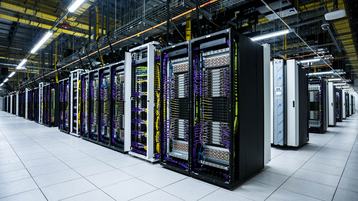
The two sites will host approximately 420,000 Nvidia GB300 GPUs between them, Musk said. Gun Range will host two single-story buildings on a 55.9-acre parcel of land. Spam will see a single-story warehouse situated on 53 acres repurposed as a data center.
"I walked the whole Colossus 2 site around midnight and again this morning. Good progress by the SpaceX team and contractors," Musk wrote on X. "Gun Range is tracking to be operational by end of November and Spam in December."
The two new data center sites will join Colossus 2’s Macrohard, Macroharder, and Minihard locations, which are set to host 330,000, 220,000, and 220,000 GPUs respectively.
Musk said that by the end of 2026, there will be a total of around 1.2 million Blackwell GPUs deployed at Colossus 2.
SpaceXAI's main data center portfolio was originally located in Memphis, Tennessee, but has since expanded across the border into Mississippi. The company, which uses the data centers for its Grok AI chatbot, first came to Memphis in 2024, launching its Colossus supercomputer in a new data center housed in a former Electrolux factory in Memphis’s Boxtown district.
It purchased the site for Colossus 2 in March 2025, and the data center came online in January. Despite Musk claiming it offered 1GW of capacity at launch, satellite imagery taken in January reportedly showed it had cooling equipment installed capable of managing 350MW.
The third data center was announced in January 2026, and is located in Southaven. News of this data center surfaced in March of this year, when the company filed a construction permit for a $659m development of another building on an adjacent land parcel. Minihard was confirmed in July 2026, with construction taking place on a parcel of land on Tulane Road near the border between Tennessee and Mississippi.
Last month, SpaceXAI revealed that it had been issued with a notice by the Mississippi Department of Environmental Quality (MDEQ) which alleges that “disturbing construction activities at sites occurred prior to coverage under Mississippi’s Large Construction Stormwater General Permit.”
The notice, which was issued to MZX Tech LLC, a SpaceXAI subsidiary, added: “MDEQ is seeking civil penalties of up to $25,000 per day, with preliminary claimed exposure of approximately $6.1 million across three sites.”
SpaceXAI said at the time it was “cooperating with MDEQ violated federal law and state regulations by constructing and operating a gas-fired power plant in Southaven, Mississippi, without required permits and is in discussions to resolve the matters through a single agreed order.”
That same week, a judge rejected an attempt by the Department of Justice to block a lawsuit that has been launched against the company by the National Association for the Advancement of Colored People (NAACP), which alleges that SpaceXAI violated federal law and state regulations by building and operating a gas-fired power plant in Southaven, Mississippi, without first obtaining the required permits.
SpaceXAI uses turbines to power both its Colossus 1 and 2 data centers. The company used a loophole in the Clean Air Act to run as many as 35 turbines without a permit for a year, but in 2025, local regulators granted a permit to run 15 turbines until 2027. The NAACP alleges that xAI has illegally installed and is operating 57 gas turbines at its Southaven facility.
In its initial court filing, the NAACP said that "the Colossus Gas Plant emits significant amounts of harmful pollutants, including nitrogen oxides (“NOx”) and formaldehyde, which are tied to increases in asthma, respiratory diseases, heart problems, and certain cancers in persons exposed to them."
In recent months, SpaceXAI has started renting its data centers to third parties, and the company has signed major compute capacity agreements with Reflection, Anthropic, and Google.



Comments