
Anthropic will pay Elon Musk’s SpaceX $1.25 billion a month over the next three years to rent space at the company’s xAI data centers, an IPO filing has revealed.
The IPO document, lodged with the US Securities and Exchange Commission ahead of rocket company SpaceX’s much-anticipated public listing later this year, lifts the lid on Musk’s firm and its plans to deploy compute infrastructure in space.
Earlier this year, Musk combined SpaceX with xAI, his AI start-up that has developed the Grok chatbot and built a cluster of data centers in Memphis, Tennessee. xAI, in turn, owns social media platform X, and together the companies could be valued at more than $1 trillion when they debut on the stock market.
SpaceX banks Anthropic billions, turns cloud provider
SpaceX announced earlier this month that it would be leasing 300MW of data center space at its xAI data centers to Anthropic.
The IPO filing reveals that AI lab Anthropic, which makes the Claude chatbot, a direct competitor of Grok, will pay $1.25 billion a month for the privilege, with the contract running until May 2029. The deal can be terminated by either party, with 90 days notice.
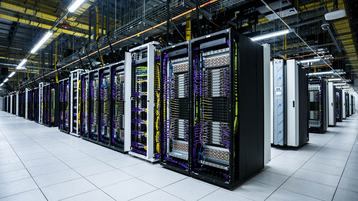
In a separate agreement announced in April, SpaceX/xAI said AI code editing startup Cursor would also be using space at xAI data centers, and in the IPO document, it reports that other firms could rent its data center capacity, effectively turning it into a cloud provider.
“We have sufficient capacity to provide compute for our own AI models, including support of our training and inference demands, and to satisfy the obligations under these agreements,” SpaceX said. “We expect to enter into additional similar services contracts for compute capacity with third parties.”
It is perhaps no surprise that SpaceX is looking to rent out some of its GPUs, given the massive losses sustained by xAI. The document shows that xAI lost $2.4 billion in the three months to March 2026, up from $936 million a year ago.
The losses stem from significant capex investments to fund its data centers. It spent $12.7bn on AI infrastructure in 2025, but had already shelled out $7.7bn in the first quarter of 2026, suggesting an annual spend closer to $30bn.
Does SpaceX really have a 1GW xAI data center cluster?
Musk has repeatedly hailed his firm’s 1GW data center cluster in Memphis, describing it as the largest in the world.
The company came to Memphis in 2024, launching its Colossus supercomputer in a new data center housed in a former Electrolux factory in Memphis’s Boxtown district.
It purchased the site for Colossus 2 in March 2025, and the data center came online this January. Despite Musk claiming it offered 1GW of capacity at launch, satellite imagery taken in January reportedly showed it had cooling equipment installed capable of managing 350MW.
The IPO document makes multiple mentions of the 1GW of data center capacity at SpaceX’s disposal, but describes it as “nameplate compute draw”. It explains this is calculated by taking “the number of GPUs installed in our data centers at the end of the period multiplied by their respective all-in power draw.
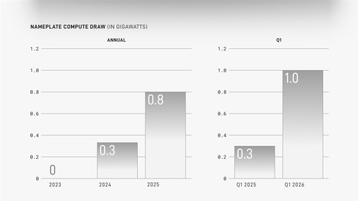
According to a chart in the IPO filing, the company’s nameplate compute draw was, indeed, 1GW in March 2026, up from 300MW a year before. However, it also notes that this figure “reflects installed capacity and does not represent actual power consumption or utilization.” So while the GPUs are installed, they may not yet be powered up, suggesting the company’s actual useful compute power could be significantly less than 1GW.
Indeed, the IPO filing only directly references 330MW of compute, 130MW at Colossus and 210MW at Colossus 2. It notes that “the next phase of expansion at Colossus 2 will bring online at least 220,000 additional GB300 processors and over 400 additional megawatts of compute power,” but does not say when this will happen.
SpaceX plans $2.8bn gas turbine spend, despite lawsuits
xAI has faced criticism for powering its data centers with polluting natural gas turbines.
It has faced multiple lawsuits from environmental and civil rights campaigners over the last two years, with the groups alleging the company’s rapid deployment of gas turbines has occurred without the correct permits and in violation of the Clean Air Act.
The latest case was launched by civil rights organization the NAACP in April, accusing xAI, and its subsidiary MZX Tech, of illegally running 27 methane gas turbines that power Colossus 2.
However, the controversy does appear to have deterred xAI from using natural gas. The IPO document said the company has deals in place to acquire new turbines worth $2.8bn. This includes a $2bn contract with an unnamed vendor agreed on April 30, which is expected to close later this month.
Can SpaceX deliver orbital data centers?
Central to Musk’s pitch to investors is that SpaceX will be able to put data centers in orbit, harnessing the power of the sun.
In January, SpaceX requested permission to launch up to one million space data center satellites, and in its IPO filing said it could launch these as soon as 2028.
Other companies, notably Jeff Bezos-backed Blue Origin, are also looking at putting compute in space, but SpaceX believes that it is uniquely positioned to deliver orbital data centers thanks to its Starlink constellation of communications satellites.
The IPO filing notes: “We plan to advance thermal control systems - many of which have been proven on Starlink - by using radiators, vapor chambers, active cooling loops, and coatings to dissipate the heat generated by AI hardware in space’s vacuum.
“We will also utilize inter-satellite lasers pioneered by Starlink for mesh networking at scale, creating coherent computing clusters across free space instead of wired connections used in terrestrial data centers. Our existing Starlink constellation, with over 23,000 inter-satellite lasers, will be a crucial enabler of orbital AI compute, as its global network allows data from our AI compute satellites in Sun-synchronous orbit to reach ground stations anywhere on Earth.”
It adds that the SpaceX AI compute satellites “will be designed for high-rate, automated production to enable the scale of satellites needed for the large amounts of compute planned in space.”
Despite this bullishness, the document also concedes that many of the technologies, systems, and operational capabilities needed to put data centers in space are “novel and untested.”
It said: “We expect to incur significant capital expenditures over a period of years before our AI products and services and other strategic initiatives, including AI compute infrastructure and in-orbit, lunar, and interplanetary industrialization efforts, become profitable, which may never occur.”








Comments