
American ground network builder Northwood Space Corp. has closed a $375 million Series C financing round to accelerate the buildout of its satellite downlink technology for US government and commercial contracts, as well as delivery of its existing commitments and talent acquisition.
Randy Glein, founder and managing partner at DFJ Growth, which co-led the funding round, said: "What goes up must come down … this is a universal truth of sending data to and from space-based networks. Northwood has emerged from a raw startup to a new-generation leader over the past year, changing the game with innovation and speed of execution to quickly surpass legacy incumbents.

"Northwood's advanced phased array technologies, innovative systems, and vertically-integrated manufacturing approach are delivering robust capabilities to demanding commercial and government customers.”
The company held its Series B earlier this year in January, raising $100m in a round led by Andreessen Horowitz around the same time it secured a $49.8m contract with the United States Space Force to upgrade its satellite control network. This followed a $30m raise in early 2025 after $6.3 million in seed funding, adding up to a grand total of $511m.
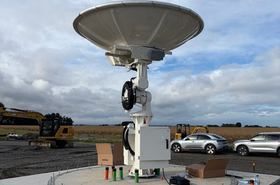
Since then, the company has opened a new 185,000 sq ft (17,187 sqm) headquarters and factory in Torrance, California, in September, increasing its manufacturing footprint fivefold, and has seen its antennas installed at six sites, while announcing its Prism and Portal antennas, capable of advancing its transmission capacity above 10 gigabits per second per site.
Returning investor Andreessen Horowitz (a16z) co-led the Series C with DFJ Growth, with a noteworthy follow-on investment from Washington Harbour Partners, Alpine Space Ventures, Stepstone, In-Q-Tel (IQT), and others. Additionally, a multi-year credit facility from HSBC Innovation Banking will also support working capital and network expansion.
At full production, the company expects to build hundreds of antennas per year, which can “go from truck arrival to live links in three to four hours,” equipping new sites in three months. Northwood hopes to enable sites to deliver 100+ Gbps in high-demand regions by the end of 2027.
The company claims that it “controls the full stack,” including “site selection,” seemingly celebrating its control over where it installs its antennas at other companies' ground stations to access their fiber connectivity.
Venture funds have been swift to back orbital data center (ODC) technology this year, along with the optical intersatellite and downlink transmission technologies that speed up the movement of the data that might be produced in those ODCs by moving it with lasers. So far, Northwood has mentioned only its phased array antennas, which transmit with the same RF medium as in the last century. The first phased array transmission was demonstrated in 1905.
In 2024, founder Bridget Mendler explained that connectivity with space was “stuck in another era,” which Northwood intended to address using phased array technology, which was capable of delivering a “10x improvement.”
RF transmission is thoroughly capable of high throughput, and while SpaceX’s new third-generation satellites are reliant on laser intersatellite links, the company claims the Gen 3’s beam-steered antennas will be able to move one terabit per second via spectrum. While the company builds its own antennas and ground stations, normalizing RF downlink volumes of this size invites demand for powerful new antennas.
Northwood was founded in February of 2024 by a six-person team led by former Disney actor and pop star Bridgit Mendler, known for the 2012 double platinum hit, Ready or Not, as well as roles in Alvin and the Chipmunks: The Squeakquel and Beverly Hills Chihuahua 2.
Mendler isn’t the only superstar turned satellite exec. MLB star Alex “A-Rod” Rodriguez publicly listed “Slam Corp” in 2022, raising $575m, a special purpose acquisition company (SPAC) that agreed to merge with Lynk Global in early 2024 before a turbulent corporate drama ensued, with the merger abandoned the following year. While a fraught example, Slam Corp certainly substantiates the financial dividends of star appeal.




Comments