
Google Cloud will double its infrastructure in Brazil by 2030.
The announcement was made on Thursday (September 24) during the Google Cloud Summit Brazil 2026 in São Paulo, and detailed by Google Cloud’s president for Latin America, Eduardo López.
According to the executive, the company has continuously invested in data centers in the country between 2017 and 2026 and will now double that capacity between 2026 and 2030.
Google launched its Brazilian cloud region in São Paulo in 2017. It is one of two cloud regions the company has in South America, alongside one in Chile that opened in 2021.
López emphasized that Google does not typically disclose investment figures and asked the journalists present at the press conference not to make estimates, but he stated that a comparison between the two periods gives an idea of the planned investment in the country.
According to him, investment in data centers in Brazil spans the company’s entire portfolio, which particularly benefits the public sector and companies in regulated industries. Also participating in the press conference were Milena Leal, Google Cloud’s country manager in Brazil, and Milton Larsen Burgese, director of the public sector for Latin America.
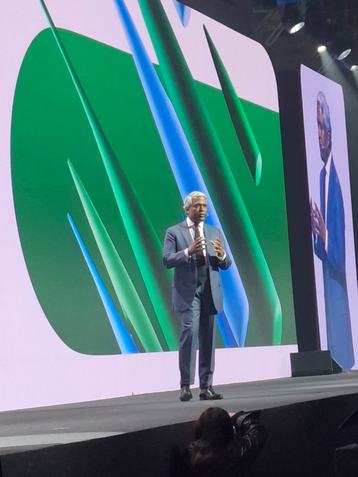
Milena had presented the plan shortly before the press conference on the event’s main stage. According to the executive, the expansion reinforces the company’s long-term commitment to the Brazilian market, aims to keep pace with the rapid adoption of Gemini Enterprise and the growing demand for artificial intelligence, and will expand local storage capacity and high-performance AI processing capabilities. At the opening of the Summit, Google Cloud’s global CEO, Thomas Kurian, noted that the company currently operates two cloud regions in the country, each with three isolated data centers, for a total of six data centers.
Processing capacity, not square meters
When asked what doubling the infrastructure means in practice, whether it involves building more data centers or expanding the capacity of existing facilities, López explained that the company talks about product and capacity, not physical space, because advances in hardware allow them to do much more with less floor space. What Google will double, he said, is its processing and service delivery capacity in Brazil, which could mean either expanding current facilities or building new ones, depending on demand.
The executive noted that the facilities follow high-availability architectures, with separate zones, and that, with increasingly powerful processors, the number of racks or buildings is no longer the primary indicator.

Regarding the possibility of a large new data center in the country by 2030, López stated that investment planning is always tied to demand and that the announced doubling reflects confidence in the growth of the platform’s use by Brazilian companies. In his view, ReData, a special tax regime recently enacted for data centers, significantly helps reduce the operating costs of these facilities, especially when purchasing components.
Blackwell GPUs and TPUs in the Brazilian data center
On the hardware front, Milena announced that G4 virtual machines, equipped with state-of-the-art Nvidia GPUs, are now available in the São Paulo region. According to the executive, these resources offer high performance and low latency, enabling Brazilian companies to run their most computationally intensive models locally. In another press conference held during the event, Flávio Franco, director of Forward Deployed Engineering at Google Cloud for Latin America, noted that at last year’s Summit, the company brought sixth-generation TPUs to Brazil and that this year, it is expanding its investment with the arrival of Nvidia RTX Blackwell GPUs at the Brazilian data center.
According to Franco, computing capacity will double in both traditional infrastructure and AI.
The company said it has optimized chips, data centers, and its network and passes these efficiencies on to customers; the new family of TPUs is claimed to deliver three times the computational performance during training and an 80 percent better price-performance ratio for inference. As a Brazilian example, it cited Axia Energia, which runs advanced weather modeling on TPU clusters, is able to predict severe weather events up to ten days in advance, and, as a result, has reduced service interruptions for millions of customers year over year.

When asked about the possibility of a new Google cable in Fortaleza, the country’s main hub for submarine cables, and about investments in data centers or connection points in the capital of Ceará, the executive explained that decisions regarding cables are made globally and that the role of the regional operation is to demonstrate demand.
According to López, Google seeks to keep its data centers close to the landing points of its own cables - which are currently concentrated in São Paulo - since relying on other connections to reach its facilities would cause latency issues. He said he had visited Fortaleza and spoken with local companies, and stated that the company is exploring alternatives for the future.
Regarding questions about the environmental impact of data centers, Burgese stated that Google Cloud operates at energy efficiency levels higher than the market average - from chips to infrastructure lifecycle management - achieving greater capacity per unit of energy, and that the company publishes this data transparently. In the case of the Brazil Google Cloud region, it operates on clean energy 90 percent of the time, which allows customers running workloads locally to benefit from the national energy mix.
Milena Leal stated that the investments are a response to customer demand and market evolution. Brazil is one of the most important countries in Latin America for technology solutions, and the company observes, in practice, rapid adoption not only of AI but also of security and infrastructure, which underpins the company’s growth projections. The executives also highlighted that the country is known for its rapid adoption of technologies, with a growing number of digital natives and higher expectations regarding service quality, and that, for the first time in the industry’s history, all sectors - from the public sector to education, from retail to finance and manufacturing - are advancing at a similar pace in technology adoption.
This piece was translated from DCD's Portuguese site and edited by a member of DCD staff.




Comments