
A novel in-rack immersion cooling method developed by Ferveret has been deployed by researchers at the Massachusetts Institute of Technology (MIT).
Scientists at MIT have been using the firm’s technology in a high-performance computing platform to accelerate AI-driven materials research for next-generation nuclear energy.
Ferveret’s technology, which is inspired by techniques used in the nuclear industry, is a form of immersion cooling that sees the server and heat exchanger contained in a small box that can be fitted into a compute rack. DCD spoke to the company’s CEO and co-founder, Reza Azizian, earlier this year.
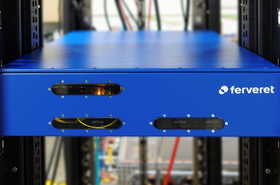
Ferveret is thinking inside the box
Bringing immersion cooling to the rack
By dispersing the heat rapidly within the box, Ferveret said it can unlock up to 35 percent more usable compute from the same power envelope.
“Ferveret's philosophy for evaluating high-performance AI infrastructure is simple: rather than relying solely on synthetic benchmarks or artificial stress tests, the company believes real scientific workloads provide a more meaningful measure of system performance while creating tangible value for researchers and others who need the compute,” said Azizian.
MIT said its AI-driven materials research “continuously pushes GPU infrastructure to its limits, providing an ideal environment to demonstrate how advanced cooling enables greater computational performance while accelerating scientific discovery.”
“Access to Ferveret's platform enables us to pursue research that simply would not be feasible with the computational resources typically available in academia. The ability to train larger models, iterate faster, and run experiments continuously is accelerating our pace of discovery. Today, compute is becoming as fundamental to scientific discovery as the laboratory itself. Advances in AI will increasingly depend not only on better algorithms, but on access to the infrastructure that makes them possible," said MIT professor Ericmoore Jossou.
Both Azizian and his co-founder, Matteo Bucci, are MIT alumni. One project supported by the company focuses on improving the analysis of coherent X-ray images collected from nuclear materials. Existing algorithms often struggle with the complexity of advanced reactor materials. Using Ferveret's platform, researchers are developing AI-based approaches that improve the accuracy and reliability of X-ray image analysis.
"Our AI workloads place sustained demands on GPU infrastructure that closely resemble the challenges found in production AI environments. That makes our research an ideal proving ground for Ferveret's technology. At the same time, the additional compute available through Ferveret's platform allows us to explore more ambitious models, complete research cycles faster, and accelerate scientific discovery," said MIT researcher DongHun Ryu.




Comments