
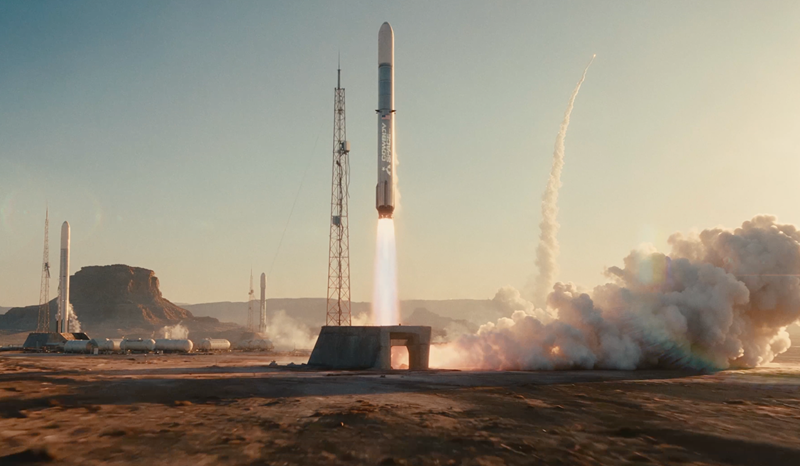
Cowboy Space Corporation, the space startup founded by Robinhood co-founder Baiju Bhatt, has revealed plans for its first rocket, “Big Iron."
The new machine is intended as a medium-lift launcher with an upper stage that can transform into a megawatt-class orbital data center (ODC).
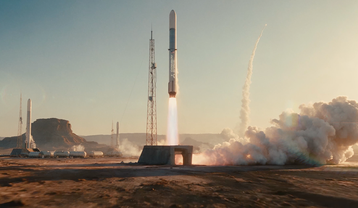
The company also intends to serve outside customers for payloads beyond compute “focused on the US” through its “Big Iron Express” service.
Cowboy is targeting 2028 for Big Iron’s first flight, after which it intends to scale its “Galactic Brain” constellation rapidly.
“We've optimized our rocket for one job: to put our own data centers to sun-synchronous orbit. That narrows the problem a lot,” Bhatt told DCD.
“We’ve chosen proven ideas over new ones. Stainless steel, methane and oxygen, and boosters that land, have all been shown to work. Our gas-generator engine is the fastest proven cycle to develop. It isn't the highest-performance engine in the world, and it doesn't have to be. Our team has done this before at the companies that did it first.”
The rocket, including its reusable booster, stands at 86 meters tall, and is intended to carry a 15,000 kg payload, putting it on the upper scale of medium-lift rockets, which NASA defines as capable of between 2,000 and 20,000 kg. The Falcon 9, the gold standard for launch in the private space market, carries 22,800 kg to LEO, according to SpaceX. Big Iron’s first stage is powered by nine liquid oxygen and methane “Clydesdale” engines, which each produce 300,000lb of thrust.
Cowboy Space Corporation, previously known as space-based solar power startup Aetherflux, filed with the FCC for a 20,000-satellite compute constellation called Stampede. The company launched its first satellite, Reason-1, on October 1 to demonstrate the laser power beaming from orbit to Earth that Aetherflux was founded to deliver. Reason-2, intended for 2027, will operate GPUs in orbit for commercial and government customers.
In May this year, the company closed its Series B at the same time as the rebrand, raising $275 million at a $2 billion valuation, for a total of $365m in funding to date. Bhatt stated he wouldn’t comment on future fundraising, but acknowledged the company would need to raise more capital to scale its rocket program as it has outlined.
Have gun – Will travel?
The Big Iron rocket, its Clydesdale engines, its solar systems, and its associated hardware are to be designed and manufactured at the company’s 260,000 square foot factory in Kent, Washington, in the Seattle metropolitan area.
“We're fitting [the factory] out now,” Bhatt told DCD. “Our rocket is 4.7 meters wide so it can travel by road, and one engine design flies both the first and second stage. That keeps the number of things we have to make smaller relative to other rockets. In general, our rule is to buy proven parts and build only what's unique. Pipe, valves, fittings and pressure tanks generally come from the supply chain. The engines, the stages and the satellite are ours.”
Clydesdale’s gas generator is testing at NASA's Stennis Space Center today.
Orbital Compute, another California-based ODC startup, recently announced its manufacturing partnership with proven German manufacturer Reflex Aerospace to deliver on its bold plan for a 100,000 ODC constellation. Bhatt wasn’t tempted by Orbital’s partnership model.
“We don't need an outside partner to design the spacecraft because the satellite and the rocket are one design, done in-house,” he said. “Led by our head of launch and propulsion Warren Lamon, our team of rocket engineers comes from the best rocket and engine programs in the country.”
A snake in my boot?
Designed to reach dawn-dusk, sun-synchronous orbit, the converted upper stage satellite is 132 meters by 73 meters and can carry five compute racks of Nvidia Space-1 Vera Rubin GPUs, which wouldn’t quite get it to a megawatt according to our napkin math.
Cowboy Space claims technical innovations in its design that serve dual purposes, designing Big Iron’s hull to double as the data center’s radiator, the ODC’s ammonia coolant as fuel for satellite propulsion, and the nitrogen used to pressurize the rocket’s second stage as the means of deploying the ODC’s solar array. The nifty solutions are intended to dismiss allegations such as Jim Chanos’ that ODCs are “AI snake oil from the Silicon Valley promoter class.”
Asked about the ODC’s ability to bring data down to Earth, a widely cited fly in the ointment of the space data center principle, Bhatt described Big Iron’s six intersatellite laser links (ISLs), each capable of 1.2 terabits per second, which would be put to the test on the company’s second mission in April 2027.
Yippee-ki-yay
The newly announced rocket arrives at a critical moment of the launch bottleneck, as satellite production scales further and further away from rocket rideshare availability. Urgency around the problem has accelerated since SpaceX announced its intention to retire the Falcon 9 in August, when Elon Musk stated that it “makes sense … [to] wind down Falcon,” which experts predicted means the rocket will be out of action after its 2028 launches.
At WSBW 2026 this year, American launch executives at Firefly, Blue Origin, and Northrop were all confidently aligned that the cost-per-kilo era of launch was over, and that a continued race to the bottom on LEO access would be the doom of the Western launch industry. Bhatt did not disagree with the bold consensus.
“We are not focused on dollars per kilogram as a single guiding metric,” he told DCD. “Our rocket's first job is launching our own data centers, so the number we care about most is the cost of a unit of AI computing in orbit compared with building it on the ground. We designed every part of the system around that.”
Usually, rocket developers start small, developing small-lift, or even suborbital rockets to gradually prove out their technology and iterate upwards in a grueling engineering process that can last over a decade, if it doesn’t ruin the company. This was the path launch winners SpaceX, Rocket Lab, Arianespace, ISRO and China took before eventually developing reliable medium-lift options.
History has not been kind to space agencies and aerospace companies that tried to skip right to the premium product in medium-lift, though such instances span pioneering eras of space transportation. Armed with engineers who worked at those newspace success stories, companies like Cowboy Space are leaping ahead to solve the launch bottleneck before the crunch.


Comments