
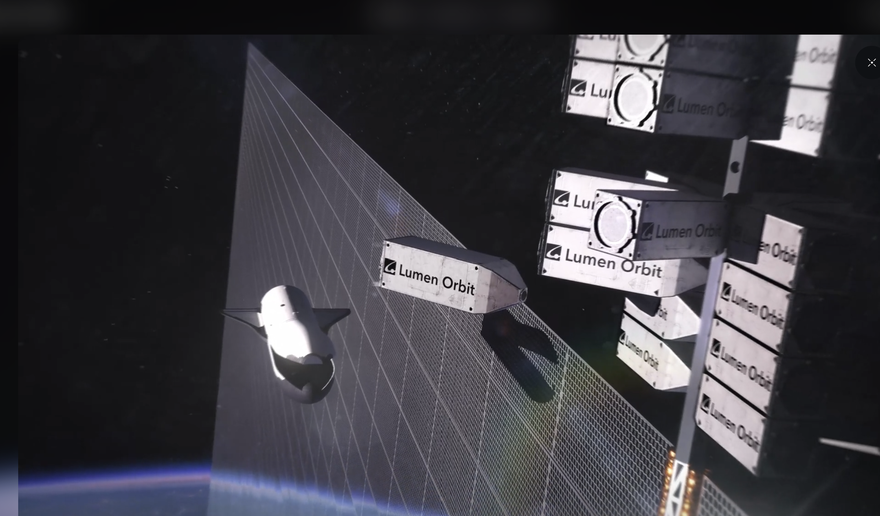
The year is star-date 2026. A manila envelope crosses the fine mahogany desk of Federal Communications Commission (FCC) chairman Brendan Carr, requesting permission to develop humanity’s furtherance as a species.
“Like steam power in the 19th century and the Internet in the 20th century, AI is a revolutionary technology,” prophesizes Cowboy Space Corporation COO Joseph Yaffe in the company’s new application to the FCC. “By putting the silicon next to the sunlight, Stampede [a 20,000 satellite orbital data center (ODC) constellation] can skip the terrestrial power grid entirely and bypass the costs and delays associated with building data centers on Earth.”
It’s nothing new to the FCC chairman, who is more than comfortable with hyperbole.
Just that January, a filing from Elon Musk’s SpaceX declared: “A constellation of a million satellites that operate as orbital data centers is the first step towards becoming a Kardashev II-level civilization.” It was soon joined by another from Jeff Bezos-backed Blue Origin, proposing its “Project Sunrise”.

DCD Magazine #61 - Life and death on a tower
The cell tower climbers risking it all to help us stay connected
The answers to humanity’s advancement are piling up at the US communications regulator, it appears, just waiting for a canny disruptor to grease up his rubber stamp and smash through the red tape shackling American greatness, and propel mankind into the future.
Silicon Valley’s billionaires and space nerds have forgotten about Martian colonies, asteroid mining, and space tourism, and have decided to direct their efforts to in-orbit data centers.
Though many firms have been eyeing orbital compute for a number of years, enthusiasm for the idea gained momentum in late 2025 after Amazon founder Bezos shared his take at Italian Tech Week in Turin last October during a fireside discussion. "[Data centers] will be better built in space, because we have solar power there, 24/7," he remarked. In the ensuing months, the idea gained popularity among the investment community and the tech market’s entrepreneurial crowd, leading to Musk advocating for the concept as an ambition of the merged SpaceX/xAI company.
In November 2025, Google unveiled Project Suncatcher, which CEO Sundar Pichai claimed would see Google place ‘data centers’ in space as early as 2027. Its first test craft successfully reached orbit last month. In March this year, Blue Origin followed suit, announcing Project Sunrise.
And so, a steady stream of applications to permit tens of thousands of new data center satellites began to stream through the FCC letterbox.
“Over a five- to ten-year horizon, orbital compute can become a multi-billion-dollar infrastructure layer, much the way terrestrial cloud evolved from specialized workloads into general-purpose infrastructure,” Rob DeMillo, Sophia Space co-founder and CEO, tells DCD. “This is not a distant market. Over the next three to five years, I expect early revenue to be driven primarily by defense and government use cases, with commercial adoption following as the infrastructure matures.”
While the feasibility of ODCs remains highly questionable, investment flows and political will are solidifying behind the trend, which may be manifesting it into iteratively more pragmatic shapes than the astral data centers initially imagined.
“Orbital hyperscalers, like SpaceX, Starcloud, and Blue Origin, aim to put tens of thousands of satellites into orbit dedicated to orbital compute. Based on historical execution timelines, we expect gigawatt-scale capacity will be reached in the early 2030s,” ABI Research’s principal analyst Andrew Cavalier says.
Heads in the clouds?
Popular concerns around the orbital data center craze have bordered on the incredulous, spoken of by some of the tech world’s most highly regarded hegemons, among them OpenAI’s Sam Altman and research house Gartner.
Infamous investment manager Jim Chanos, known to some as the “catastrophe capitalist” for his success short-selling disastrous enterprises, reposted a SpaceX video unpacking its space data center aspirations with scathing remarks. "This is more AI snake oil from the Silicon Valley promoter class,” he wrote.
Speaking with media in New Delhi, India, earlier this year, Altman drew laughter from a crowd after explaining, "I honestly think the idea with the current landscape of putting data centers in space is ridiculous. Space is great for a lot of things. Orbital data centers are not something that's going to matter at scale this decade.”
This discourse isn’t rooted in the fear, uncertainty, and doubt (FUD) so often dismissed in tech bro circles. Meaningful scaling of compute in orbit means bigger space-capable solar capacity, and likely the specialist cooling technologies to support processors. This, combined with the hard limitations of Earth downstream volumes and the ionization risk from cosmic radiation, compounds the complexity.

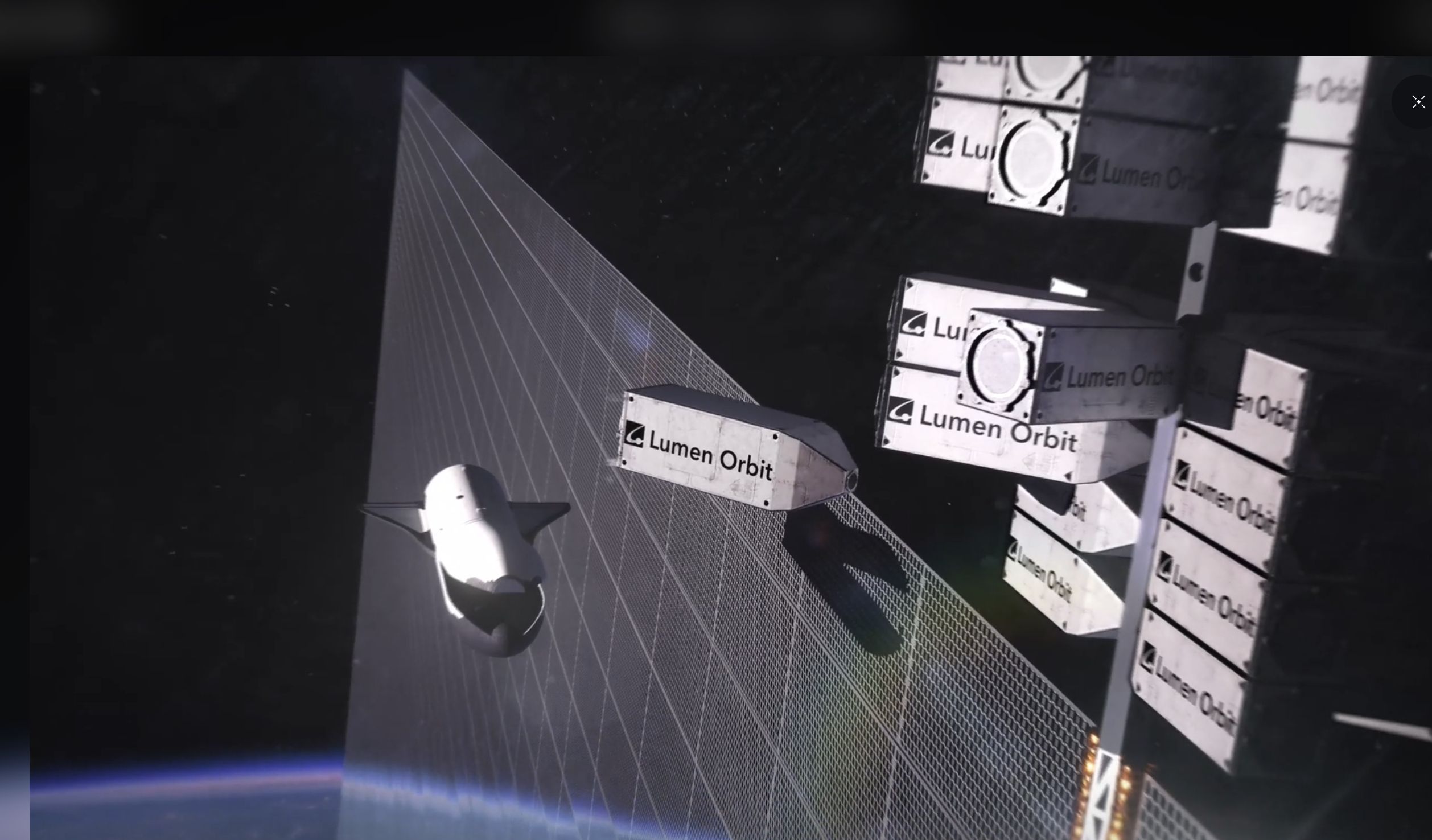

“The cost of gallium arsenide photovoltaic solar panels – the space-grade standard – runs two to three orders of magnitude more than terrestrial solar panels, and that sits alongside launch costs and cooling system requirements that make the current economics challenging to justify,” ABI’s Cavalier explains. “These barriers will be eroded over time, however, as launch costs fall and manufacturing and supply chains adjust for the scale of these systems.”
Falling launch costs have tended to prove out, not least with breakthroughs like SpaceX’s Starship well underway. However, other issues, like those that hinge upon fundamental material science, could prove fatal.
“The challenges are real,” Sophia Space’s DeMillo agrees. “But they are not hard barriers. Space punishes assumptions borrowed from Earth. Thermal management, radiation, power, communications, and autonomy all matter. But if you design for orbit from the beginning, some of those constraints can become architectural advantages.”
It’s a challenge even constellation engineers are austere about. In an S-1 filing from SpaceX discussing its orbital AI compute, industrialization in orbit, lunar, and interplanetary endeavors, the company said these efforts would “involve significant technical complexity and unproven technologies, and may not achieve commercial viability."
One semantic aspect to this conversation has been the widespread phasing out of the literalism of the orbital data center, replaced with a more disaggregated vision of orbital compute in which multi-role satellites with expanded compute capacity perform in-orbit processing that optimizes satellite imaging – one of the more taxing demands of the modern satellite industry.
“You don’t need a single, monolithic ‘space data center’ to make this work,” Cowboy Space’s Yaffe tells DCD. “You start small, iterate quickly, and scale through thoughtful design. … These are solvable problems, and they’re already being worked across the industry.”
Iterating into what?
It can be easy to rationalize this push for orbital compute as a means of clutching at the coattails of the AI and data center boom, ably joining dots into the equally exciting world of space markets. That cynicism is most potent when you consider the topic from the angle of a solution in want of a problem – besides the optimization and categorization of JPEGs of Earth, and other demanding data operations, what is an order of magnitude jump in orbital compute supposed to do?
“For defense users, the value is straightforward: faster access to intelligence,” DeMillo says. “Reduced dependence on ground infrastructure, more autonomous operations, better resilience, and the ability to process sensitive data closer to where it is collected.”
Yaffe builds upon that offer, proposing the electrical powering of persistent military operations “whether that’s powering remote bases, supporting autonomous systems, or enabling real-time data processing in contested environments.” He refers to Cowboy Space’s origins as Aetherflux, a space-based solar power (SBSP) startup founded in 2024 before it rebranded in May, originally seeking to beam power to where it is needed planetside.
Both execs recall the history most space technologies possess, originating as government and military programs and commercializing after being sufficiently incubated by defense revenues. They also both agree that this trajectory suggests a roadmap that eventually places AI capability into space.
“[After compute demonstrations] we will see more AI inference in orbit,” DeMillo suggests. “I do not think broad AI training in orbit is imminent. Inference is the near-term opportunity. Specialized training or model adaptation may come later. Longer term, orbital compute becomes a complementary extension of terrestrial data centers, not a replacement.”
Joseph Yaffe is more bullish.
“Space-based AI is not a distant concept – early systems are already being tested and deployed,” he says. “Over the next few years, we’ll see advancements and refinements in scale, reliability, and economic viability. Longer term, as AI demand continues to outpace terrestrial constraints, orbital compute shifts from an alternative to a necessary layer of global infrastructure.”
What’s China’s deal here?
China’s propensity to both advance steadily into strategic industries and maintain cognisance with American tech markets puts it on a collision course with this race for orbital compute. In fact, it can be argued that the country has already assumed a modest lead.
“China was the first to put up a dedicated multi-satellite constellation focused on orbital compute,” reports Cavalier, who has tracked Chinese developments from ABI Research’s Singapore office. “China has the talent, manufacturing base, and funding to brute force their orbital data centers into reality. I expect that orbital data centers will become as much about sovereignty as any other technology in the stack.”
Cavalier refers to the ‘Three-Body Computing Constellation’, curiously anglicized to recall the Liu Cixin award-winning science fiction novel ‘The Three-Body Problem.’ Also known as 星时代 (romanized Xingshidai) 16, the 12-satellite “AI Cloud” constellation designed by Chengdu Guoxing Aerospace Technology Co. (or ADA Space), which reports aspirations to eventually scale to a 2,800-strong fleet.
China expert Dr. Brendan Mulvaney, director of the China Aerospace Studies Institute of the US Air Force, defines Xingshidai as a leading project, but adds that it is not well-defined. Led by Zhijiang Laboratory, it is backed by big sino-sphere investors such as Alibaba. Wang Jian a veteran of AliCloud without a space background, heads the scheme.
“The project does not really have a clear vision of what they're trying to do, how they're going to do it, etc., and they've had trouble attracting top talent. After launching the first 12 satellites in May 2025, they haven't done anything substantial since. That being said, for a number of reasons, we should expect a steady development of on-orbit computing in China,” Mulvaney told DCD.
He identifies three such reasons: strategic utility, the difficulty with which China is finding access to ground stations overseas (motivating a stronger orbital layer to route data), and the nation’s likelihood of successfully deploying at least one large non-geostationary constellation like Guowang or SpaceSail.
Another mysterious, enterprising company, Orbital Chenguang Technology Co., recently obtained a ¥57 billion (US$8.7bn) line of credit from a consortium of state-owned banks, another development Mulvaney admits does not possess immediately clear terms, though with a shocking headline figure.
“There are a lot of other, smaller efforts of startups raising money for on-orbit data centers,” he adds. “Well-established companies like Galaxy Space also seem quite bullish about space computing. In short, it's a very hot topic in China today.”
This advancement hasn’t been lost on orbital compute technologists in the West.
“[China’s] activity reinforces the point that orbital compute is not just a technical curiosity,” Sophia Space’s DeMillo says. “It is becoming geopolitically relevant. The question is not whether the technology will matter, but who sets the standards, controls the infrastructure, and builds the trusted systems that other countries and companies are willing to use. That makes it important for the US and its allies to move quickly, but also thoughtfully.”
Mulvaney describes the Chinese market as extremely excited by orbital compute, but has seen the same reservations about the technology too, reporting signs that Beijing has been wary of the over-exuberance of the private market, hoping to rationalise enthusiasm.
“The Economic Daily [a state-owned newspaper] published a piece about space computing that was somewhat optimistic, but also talked about the limitations of space computing, making it clear that it's fairly niche for now,” he says.
Whether or not orbital compute is a good idea, or can work as its advocates expect it to, China appears set on putting its weight behind it, which tends to mean it's going to get done come hell or high water.
“China absolutely has examples of waste, overcapacity, and failed industrial policy, but we also consistently underestimate China’s ability to sustain long-horizon industrial coordination, absorb inefficiency in pursuit of strategic capability, and iterate after failure,” Mulvaney notes. “If the CCP, PLA, or PRC sees a long-term strategic benefit, they are willing to forgo some (or all) profitability in order to achieve those gains. By 2030, I would expect China to demonstrate some level of orbital compute, which will probably include larger-scale orbital AI constellations, likely with some autonomous onboard processing for ISR missions.”
Before we know it, the argument for orbital data centers could turn from promises of transhuman utopia into a caustic facet of the new space race.
Comments